

Professor Fred Hollows was an ophthalmologist renowned for his work restoring sight to thousands of people around the world.
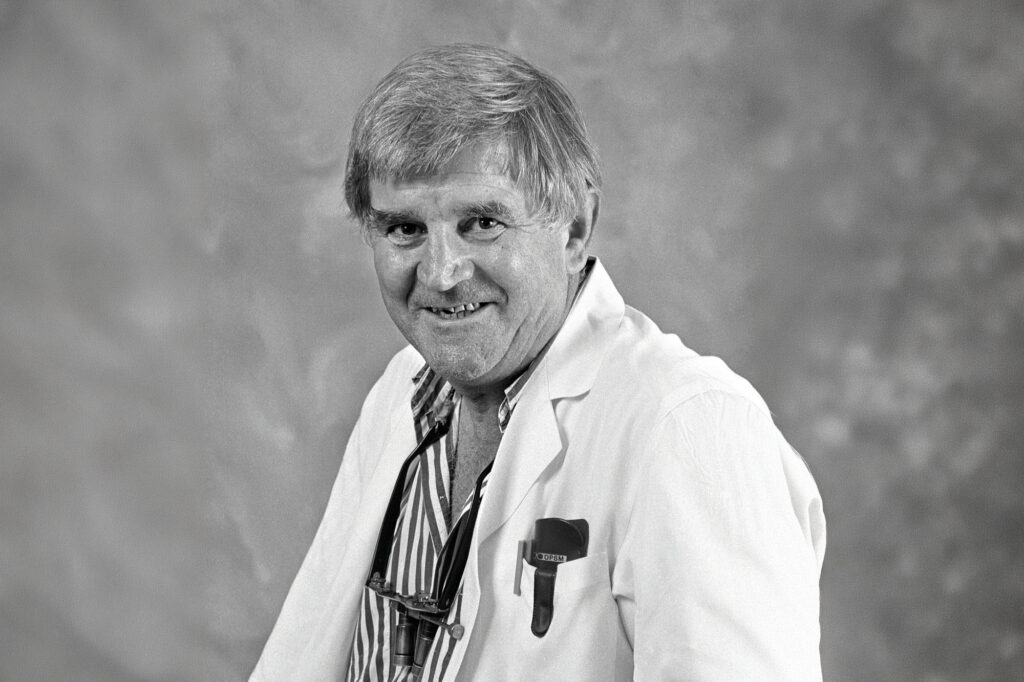 Born on April 9, 1929, in Dunedin, New Zealand, Hollows grew up with a strong sense of social justice and a passion for helping others. His early life in a devoutly religious family instilled in him values of compassion and service, underpinning his life’s work.
Hollows initially pursued a career in theology but after taking a summer holiday job at a mental health facility he began to think differently and switched to study medicine at the University of Otago. After graduating in 1956, Hollows began assisting eye surgeons in various hospitals across New Zealand and became so interested in their work, that he moved to the United Kingdom to specialise in ophthalmology.
In 1965, Hollows moved to Australia and became Associate Professor of Ophthalmology at the University of New South Wales. His work took a transformative turn in the late 1960s when he visited rural indigenous communities in Australia and witnessed the widespread prevalence of curable eye diseases, particularly trachoma – which can lead to blindness. The appalling conditions and the lack of medical services in these communities profoundly affected Hollows. He was struck by the stark disparity in healthcare access between indigenous and non-indigenous Australians.
Determined to address this inequality, Hollows established the National Trachoma and Eye Health Program in 1975, along with a team of doctors and nurses. Over the next few years, the team travelled extensively across Australia, visiting over 465 remote indigenous communities and treating approximately 100,000 people.
In 1980, Hollows married Gabi, an orthoptist, and this was the beginning of a lifelong partnership to create change for indigenous Australians and those in developing countries.
In 1985, Hollows visited Nepal, Burma, Sri Lanka, India and Bangladesh on behalf of the World Health Organization. Two years later, he visited Eritrea. Visiting these countries prompted Hollows to search for ways to reduce the cost of eye care in developing countries. His efforts culminated in the establishment of intraocular lens factories in Eritrea and Nepal, which produced low-cost lenses for cataract surgery. These lenses were otherwise prohibitively expensive for many in these regions.
Hollows’ approach was revolutionary because he emphasised training local healthcare workers and equipping them with the skills to continue the work independently. He believed that empowering local communities to take charge of their healthcare was crucial for sustainable improvement.
Despite being diagnosed with cancer in 1989, Hollows was determined to keep working. With only a few months to live he discharged himself from hospital to travel to Vietnam, training over 300 Vietnamese eye specialists.
In 1992, he and Gabi set up The Fred Hollows Foundation to ensure Hollows’ work would continue. The Foundation now works in more than 25 countries and has restored sight to over three million people worldwide. It continues to adhere to Hollows’ principles of training local doctors and building sustainable healthcare systems.
Fred Hollows died on February 10, 1993, but his spirit lives on through The Fred Hollows Foundation and the many lives he touched. His story is a testament to the profound difference one individual can make through dedication, compassion, and a relentless pursuit of justice. Hollows’ work continues to inspire future generations of medical professionals and humanitarians committed to making the world a better place.
To learn more about The Fred Hollows Foundation NZ or donate to give someone the gift of sight go to hollows.org.nz